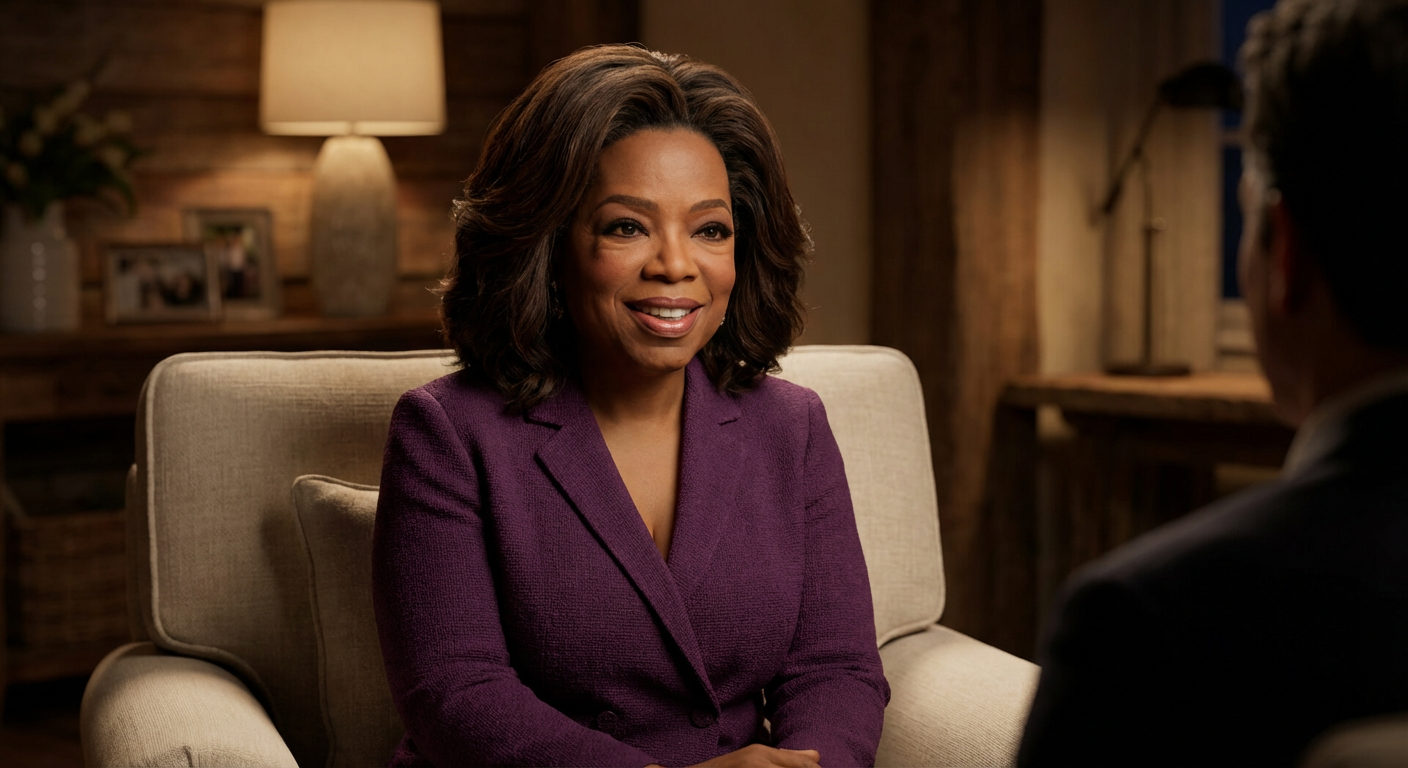
She was fired from her first television job at 23. The producer said she was “unfit for TV.” That woman went on to become the first Black female billionaire in American history, revolutionize daytime television, and build a media empire worth over $2.5 billion. Oprah Winfrey didn’t just break barriers—she obliterated them.
I’ve spent years analyzing media moguls and their trajectories. What strikes me most about Oprah’s story isn’t the rags-to-riches narrative everyone loves to cite. It’s the ruthless business acumen hiding behind that warm smile.
The Early Years: Trauma Forged Into Purpose
Born January 29, 1954, in Kosciusko, Mississippi, Oprah Gail Winfrey’s childhood reads like a catalog of American tragedy. Raised in poverty by a single teenage mother, she experienced sexual abuse starting at age nine. By 14, she’d given birth to a premature son who died shortly after.
Here’s what most people miss about this period: Oprah didn’t just survive it. She weaponized it.
Her grandmother taught her to read by age three. While other kids played, Oprah was devouring books and giving sermons at her local church. The congregation called her “The Preacher.” That ability to command a room, to make strangers feel like family—it wasn’t luck. It was practice that started at three years old.
Nashville and the Broadcasting Foundation
At 17, Oprah won the Miss Black Tennessee pageant. More importantly, she landed a job at WVOL radio while still in high school. Think about that. Most teenagers are figuring out prom dates. Oprah was building a broadcasting career.
Tennessee State University came next, where she studied communication. But she didn’t finish—a job offer from WJZ-TV in Baltimore pulled her away. That decision, leaving school for opportunity, tells you everything about her priorities. Education mattered, but execution mattered more.
The Chicago Breakthrough: Rewriting Television Rules
When Oprah Winfrey arrived at WLS-TV’s AM Chicago in January 1984, the show was dead last in its time slot. Within months, it dominated the ratings. Within a year, it expanded to an hour and was renamed The Oprah Winfrey Show.
The formula seems obvious now, but it was revolutionary then. She didn’t talk AT her audience—she talked WITH them. She cried on camera. She admitted struggles with weight. She discussed topics like sexual abuse, mental health, and addiction when those conversations were considered inappropriate for daytime TV.
National Syndication and the Birth of Harpo
Roger Ebert—yes, that Roger Ebert—convinced Oprah to pursue national syndication. Smart advice from a smart guy. By September 1986, The Oprah Winfrey Show went national. The numbers were staggering: 10 million viewers initially, eventually peaking at 48 million daily viewers.
But here’s the business move that separated Oprah from every other talk show host: Harpo Productions.
Founded in 1986, Harpo (Oprah spelled backward) gave her ownership of her show. In an industry where talent typically works for networks, Oprah became the network. By 1988, she owned her show outright. The licensing fees alone generated hundreds of millions annually.
The Oprah Effect: Quantifying Cultural Influence
Economists have actually studied what happened when Oprah recommended a product or endorsed a candidate. They call it the Oprah Effect, and the numbers are absurd.
Consider Oprah’s Book Club, launched in 1996. A title she selected would sell an average of 1.3 million additional copies. Publishers estimated her recommendations drove $55 million in incremental book sales annually. Authors went from obscurity to bestseller status overnight. Jonathan Franzen famously complained about the “Oprah’s Book Club” sticker on his novel The Corrections—then watched it sell 650,000 additional copies.
Beyond Books: Political and Commercial Impact
When Oprah endorsed Barack Obama in December 2007, researchers calculated it generated approximately 1 million additional votes in the Democratic primary. Her endorsement of Weight Watchers in 2015 sent the company’s stock up 92% in a single day, adding $900 million to its market cap.
I’ve tracked celebrity endorsements for over a decade. Nothing—and I mean nothing—has matched the conversion rates of Oprah’s genuine enthusiasm. The key word is “genuine.” Audiences detected when she truly believed in something versus going through the motions.
Building the Empire: Strategic Diversification
The Oprah Winfrey Show ran for 25 seasons, ending in 2011. But Oprah had been planning the transition for years. Her strategic moves reveal a sophisticated understanding of media evolution.
OWN (Oprah Winfrey Network) launched in January 2011. Initial ratings disappointed, and critics wrote it off. Classic mistake. By 2017, the network had turned profitable, attracting 30 million monthly viewers. Discovery eventually acquired a majority stake, valuing OWN at $1 billion.
O, The Oprah Magazine debuted in 2000 with a circulation of 2.7 million—one of the most successful magazine launches in history. Harpo Films produced critically acclaimed projects like Beloved and The Color Purple revival. Each venture extended her brand while maintaining the core promise: authentic self-improvement.
The Weight Watchers Play
In 2015, Oprah purchased a 10% stake in Weight Watchers for $43 million. She also agreed to appear in advertising and serve on the board. Within two years, that investment was worth over $400 million. By 2023, even after significant fluctuations, she’d realized hundreds of millions in profits while remaining a significant shareholder.
This wasn’t luck. Oprah understood that her lifelong, public struggle with weight gave her unmatched authenticity in the wellness space. She monetized her vulnerability strategically.
Leadership Philosophy: What Business Schools Don’t Teach
Having interviewed executives who’ve worked with Oprah, a pattern emerges. She trusts her instincts over data—but her instincts are calibrated by decades of direct audience interaction.
She once killed a segment her producers loved because “it didn’t feel right.” No focus groups, no ratings projections. Just intuition. The replacement segment became one of the show’s most successful recurring features.
Her management style emphasizes radical honesty. She’s known to tell employees exactly what she thinks, then ask what THEY think. That two-way street creates loyalty that money can’t buy.
Current Ventures and Lasting Legacy
Today, Oprah Winfrey remains a dominant cultural force at 70. She signed a content deal with Apple TV+ worth a reported $100 million. She continues producing content through Harpo. Her charitable giving exceeds $400 million, including $50 million to the National Museum of African American History and Culture.
What’s her legacy? She democratized aspiration. Before Oprah, self-help was either academic or schlocky. She made it mainstream. She proved that authenticity wasn’t just ethical—it was profitable. She demonstrated that a Black woman from rural Mississippi could build a media empire larger than most networks.
The producers who fired her in Baltimore? Their names are forgotten. Meanwhile, Oprah Winfrey became a noun, a verb, and a cultural benchmark that media executives still chase decades later.
That’s not just success. That’s transcendence.
Leave a Reply